As a birding guide and avid birder, I am often asked this question. It’s difficult to answer. Rather than trying to choose just one, I’ll profile seven favorites, including one family.
Avian Architects: Bushtits


These small gray-brown birds with long tails and a soft, chimy call are extraordinary architects. Imagine a bird weighing just a few ounces using its tiny beak and feet to weave a foot-long, pendulous nest that hangs from a tree branch. Constructed from spider webs and plant fibers, the nest is beautifully camouflaged with bits of lichen and moss. Remarkably, these sock-like structures cradle a squirming family of chicks while withstanding the rain and wind of the spring nesting season.
 Bushtits are also highly social birds. Except during the breeding season, when they pair up, they are usually seen in lively flocks of 10–40 individuals. The groups move together through shrubs and trees, gleaning insects as they go. They are also frequent and welcome visitors at backyard suet feeders.
Beauty: Resplendent Quetzal
 This was a tough choice, with thousands of contenders. For now, I’ll settle on a bird whose colorful elegance has inspired people since the time of Aztec and Mayan civilizations, whose chiefs often wore its feathers.
The first time I saw one in Costa Rica, its dangling fluorescent-green tail caught my eye. I thought it was a strip of green flagging hanging improbably high in the forest canopy. Then as I followed it up to the bird’s body, I could barely hold my camera still at the sight of this absolute stunner. Even more remarkable, quetzals subsist largely on a diet of wild avocados. It seems like a fantasy bird, but fortunately this fantasy still exists in Central American cloud forests.
Bird Family: Manakins


In the early 2000s my family and I took a bus tour of Costa Rica that explored many aspects of this fascinating country; our guide, Elston, quickly noticed our interest in birds. One morning he took us birding with on Tortuguero Island on Costa Rica’s Caribbean coast.
As we walked, I heard sounds like small sticks snapping. When I asked Elston what was making them, he replied in his deep, velvety voice: “Ma-na-kin!” Later I learned that manakins produce this sound by snapping their wings over their heads and clicking their wing bones together. Add to that their remarkable courtship dances—including a version of Michael Jackson’s moonwalk along branches—and their strange, almost extraterrestrial wing vibration sounds. It’s hard not to be enchanted. These colorful, chickadee-sized birds are high in charisma. There are 60 species of manakins (I have seen 13) in Central and South America.
Dinosaur-like Birds: Southern Cassowary
Actually, birds are living dinosaurs—all 11,000 species of them—descendants of theropod dinosaurs. Cassowaries resemble their ancient ancestors more than most .
.
 Second only to ostriches in size, they stand about five feet tall and can weigh up to 130 pounds. Their powerful legs end in oversized feet with sharp talons capable of delivering a kick that can seriously injure—or even kill. These enormous flightless birds also have brilliant cobalt-blue heads, a red nape, a horn-like casque on top of the head, and a conspicuous wattle.
Cassowaries occur only in tropical forests of northeastern Australia and Papua New Guinea. As biologist and author Tim Low has noted, “Cassowaries are vital to rainforests for all of the seeds they spread.”
I watched one eye-to-eye—from a safe distance and close to the van in case a quick retreat was necessary—in Queensland, Australia. Seeing one was a thrill of a lifetime.
Charismatic Microfauna: Calliope Hummingbird
 The smallest hummingbird in the United States weighs about as much as a ping-pong ball, yet migrates some 5,000 miles round-trip from Mexico to breeding grounds in the high meadows and open pine forests of the western U.S.
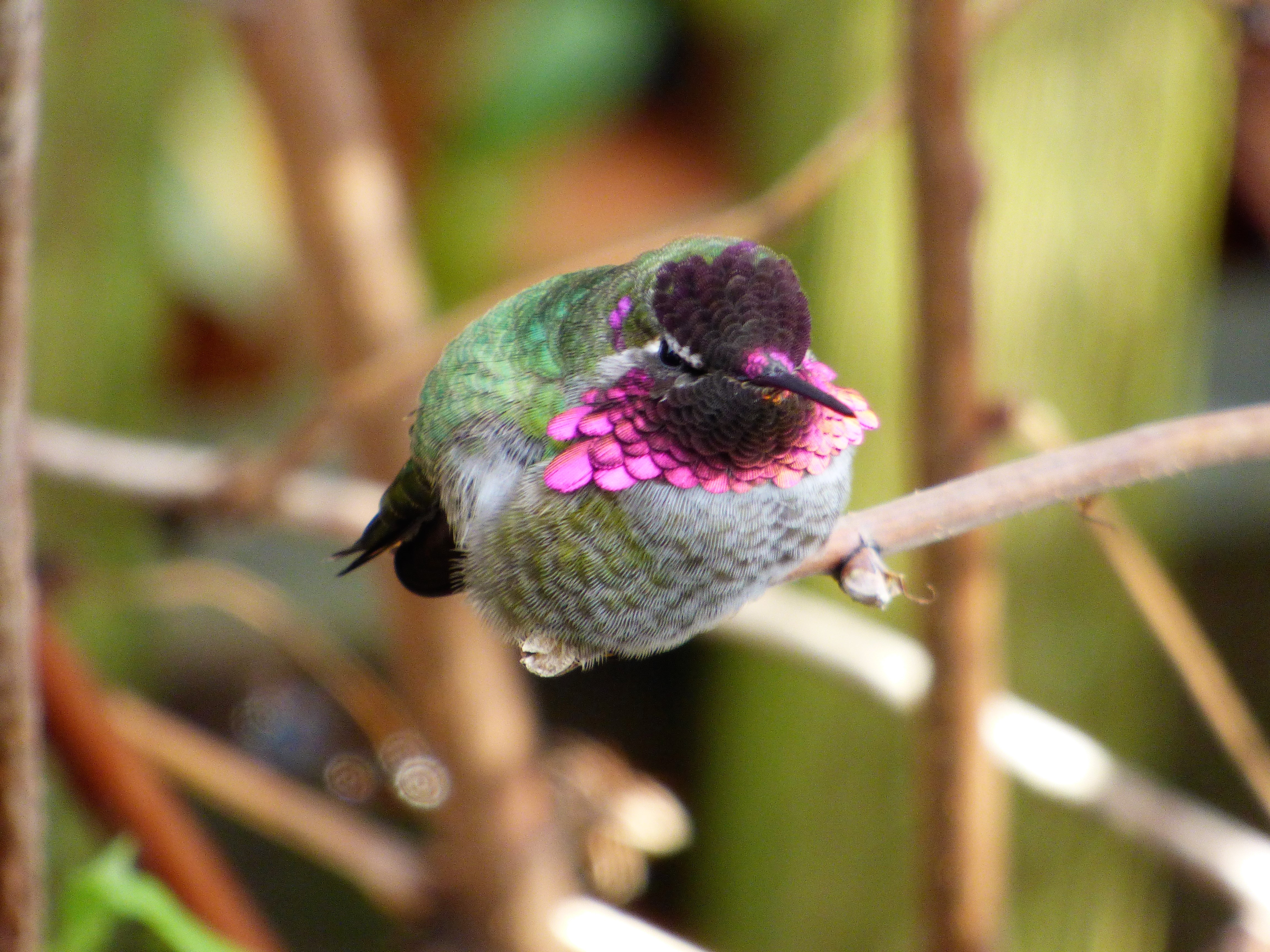
In spring you can find Calliope Hummingbirds perched on the tips of bare shrubs in meadows east of the Cascades in Washington and Oregon. Like other hummingbirds, they vigorously defend their territories, chasing birds as large as American Robins and even Red-tailed Hawks. The male’s gorget—the throat patch—resembles a tiny fluorescent purple glove, its “fingers” sometimes fluttering in the wind.
 Unique Family Member: Lewis’ Woodpecker
As Cornell’s All About Birds describes it, “The Lewis’ Woodpecker might have woodpecker in its name, but it forages like a flycatcher and flies like a crow.” I noticed this the first time I saw two in central Washington along the Naches River, in open pine woodlands. These striking Woodpeckers perched atop pines, then made short flights to capture insects before returning to their perch.
Their colors were memorable too: a striking combination of salmon pink and green. Meriwether Lewis first recorded this bird in 1805. As a naturalist, I imagine he too was surprised by both its unusual behavior and its remarkable plumage. Unforgettable!
Song: Varied Thrush
 An icon of temperate old-growth forests, the Varied Thrush sings haunting, ethereal notes and wears striking plumage of burnt orange and deep blue. Like other thrushes, it can produce two tones at once, giving its song the quality of a hum and whistle combined.
The famed twentieth-century bird artist Louis Agassiz Fuertes, a friend of Cornell Lab founder Arthur Allen, described the Varied Thrush’s simple, contemplative song as “perfectly the voice of the cool, dark, peaceful solitude which the bird chooses for its home.”
Water Bird: Harlequin Duck
 Harlequin Ducks live in exquisite surroundings. This is due to their habitat preference for fast-flowing waters. Harlequin Ducks eat insects, fish and marine invertebrates, often on or near the bottom of the sea/river.
This waterfowl species breeds on forested mountain streams in the North Cascades, Northern Rockies and Selkirks in the West and in the Laurentian Mountains in northeastern Canada. They winter on rocky shorelines with turbulent wave action and strong tidal currents. In the spring and summer, you can find them in mountain streams in places like Glacier, North Cascade or Olympic National Parks. During fall and winter, they inhabit places like the San Juan Islands, Gulf Islands, or coastal Maine.
The name “harlequin” is derived from comic entertainers in Europe who wore colorful, distinctively patterned costumes, thus the Latin name for this striking duck: “Histrionicus histrionicus.”
——————————————
In the end, even choosing seven favorites was difficult. There are countless other species with astonishing abilities—beautiful songs, breathtaking athleticism, gorgeous plumage, and extraordinary navigational feats.
As I often tell people, if all you care about is beauty, that alone is reason to watch birds. I like to think of the wintering ducks in our area as floating art.
And if birds were like people, I would probably have multiple lawsuits on my hands from species claiming they were unfairly overlooked. But that’s part of the joy of birding. The wonders never cease, their behavior is captivating, and their connections to different habitats are fascinating. The diversity of birds across the world is astounding.