

Why would we leave the Pacific Northwest during May — when our diverse and abundant natural lands and shores are exploding with birdsong and spring migration? For one reason: warblers. Every spring, the north and south shores of Lake Erie become one of the greatest migration spectacles in North America, concentrating astonishing numbers of these tiny, colorful, charismatic, and at times, elusive birds as they push north toward their breeding grounds.
Following a epic annual northerly voyage, exhausted migrants funnel into a narrow band of shoreline habitat, aka a “fall-out” zone, turning places like Magee Marsh Wildlife Area and Point Pelee National Park into legendary birding hotspots. According to Connecticut Audubon Society, “Millions of migratory birds, including more than 30 species of warblers, travel north to the Lake Erie shoreline each spring.”
Having heard stories about this phenomenon for decades — and intrigued by the geography that creates such an extraordinary concentration of migrants — a small group of us finally made the pilgrimage during peak May warbler migration.
 Both Magee Marsh and Point Pelee host major birding festivals in May: The Biggest Week in American Birding at Magee Marsh and the Festival of Birds at Point Pelee. Although we did not participate in either festival, we shared sightings with tour groups at both locations.
Each spring, roughly 36 species of warblers (we saw 22), along with countless other birds, migrate north from wintering grounds in Central and South America to breeding territories across the United States and Canada. Along the way, they must cross the Gulf of Mexico and survive storms, predators, buildings, wind turbines, and countless other hazards.
By the time they reach the south shore of Lake Erie, they are exhausted. The result is a classic migratory “fallout,” in which birds descend into the forests and marshes to rest, feed, and regain strength for the next push — often a 60-mile crossing of Lake Erie into Canada. Some species remain to breed in Ohio and in the northern United States.

Experiencing this migration is extraordinary. The woods are alive with movement. Bushes shimmer with brilliantly patterned warblers, while tanagers, grosbeaks, vireos, and hammering woodpeckers fill the trees. Flocks of birds fly overhead. Birdsong dominates the soundscape, accompanied by the waves of Lake Erie and wind blowing through the forest canopy. When you stop to consider that millions of these tiny birds — most weighing ounces, not pounds — have flown from the neotropics to the Great Lakes and beyond, only to make the journey south again in autumn, it feels nothing short of miraculous.
In a world where humans have inflicted enormous damage on the environment, it is heartening that these migrations persist, even as bird populations decline. Roughly half of migratory birds do not survive the journey. Yet evolution has deemed the risks worthwhile in the ongoing struggle to survive, reproduce, and raise young.
Humans, however, have also done something remarkable: we have protected thousands of acres of forest, prairie, and marshland along the Ohio and Ontario shores of Lake Erie. At Magee Marsh Wildlife Area, conservation efforts began in 1951, when Ohio designated Magee Marsh — once part of the vast Great Black Swamp — as its first state-managed wetland preservation and restoration area. Federal funding later helped create the adjacent Ottawa National Wildlife Refuge and Cedar Point National Wildlife Refuge.

Point Pelee National Park has an even longer conservation history. It became a Canadian National Park in 1918 at the urging of ornithologists, birders, and hunters. French explorers named it “Pointe-Pelée,” meaning “bald point,” for its rocky, largely treeless eastern shore.
One birder at Pelee Point showed me an astonishing cellphone photo she had just taken of a Cerulean Warbler resting on the sandy, rocky tip of Point Pelee — the southernmost point of mainland Canada. It was a vivid reminder of how vital this narrow strip of land is to migrating birds. The point itself is so narrow that I was literally able to straddle it in a yoga “downward dog” position.


Among the most memorable birding experiences was searching for and finding an American Woodcock – a “Life Bird” for me. It took three evening outings to finally encounter one in Point Pelee National Park. At dusk, we heard the telltale “Peenk” call, saw the stocky bird with a long bill, watched it launch into the air where it created an aerial twittering sound with its wings as it descended back to earth — all part of its spectacular mating dance. In addition to its stunning dance, American Woodcock’s have another superpower: their eyesight. According to the book Bird Trivia by Stan Tekiela “The American Woodcock has the greatest field of vision…in the entire bird world. It has large, bulbous eyes, which allow it to see a full 360 degrees, as well as straight up overhead.” This earth and leaf-colored bird with a long bill and outstanding eyesight inhabits moist forest floors and wetlands where it probes for earthworms.
Beyond the outstanding birding, we also visited the excellent National Museum of the Great Lakes in Toledo, saw a movie production of The Devil Wears Prada 2 in Leamington,Ontario, explored the historic streets and murals of Kingsville, Ontario and toward the end of our journey, stopped at the outstanding University of Michigan Museum of Art. We combine natural and cultural history on our travels; together they create richer, more rewarding journeys while also supporting local ecotourism.


This trip surpassed every expectation. We saw 126 species of birds and 22 warblers (check out “bouquet” below). Seeing the extensive protected marshes and forested wetlands that provide immeasurable conservation value was beautiful and inspiring.
Equally memorable was the kindness of the birding community. Everywhere we went, birders were generous with their knowledge and eager to share sightings. Thankfully, the birding world appears to be growing younger and more diverse.
In sum, we had a wonderful time on both sides of Lake Erie and thoroughly enjoyed the hospitality of locals and the companionship of fellow birders.
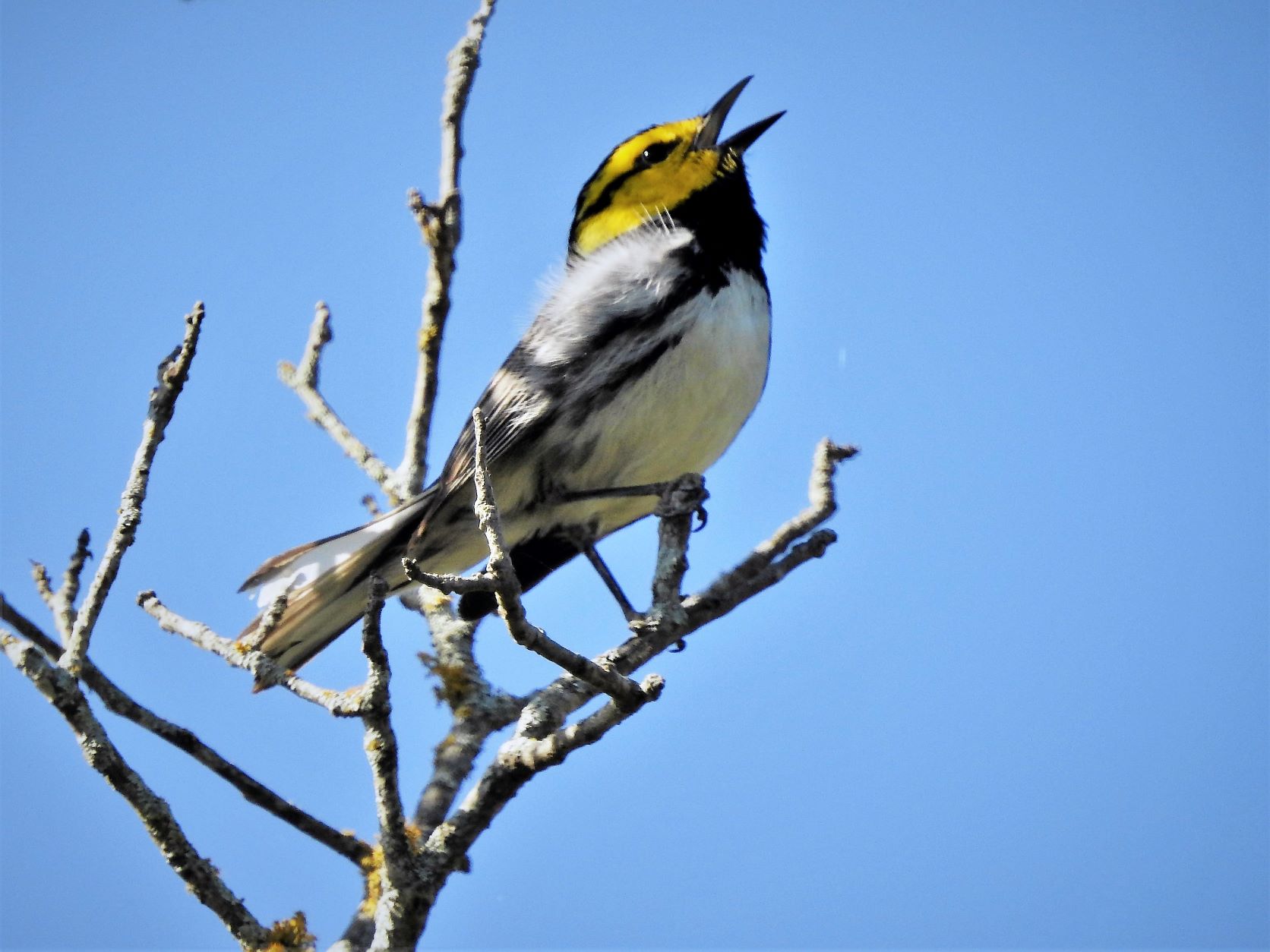
I close with a bouquet of warblers: